How to be prepared in an emergency
⚠️ Important health advice
This guide is intended to provide general information on crisis preparedness. Water stored incorrectly can become contaminated. If in doubt, or if using stagnant water from unknown sources, always filter and boil it before consumption!
A power cut affects the water supply more severely than many people realise. Without electricity, pumps and treatment systems often stop working – clean drinking water quickly becomes scarce. That is why it is crucial to know how to secure your water supply during a power cut and how much water you actually need in an emergency.
In this guide, you’ll learn how to store water properly, how long it lasts, and what solutions are available to ensure you still have clean water even without electricity. We’ll also show you which methods for treating drinking water are useful in an emergency and what you absolutely must bear in mind.
The water supply during a power cut is based on three key points:
- Storing water
- Treating water
- Planning water consumption
| Preparedness pillar | Shelf life / capacity | Key measure | Wolf’s unvarnished verdict |
|---|---|---|---|
| 1. Long-lasting supply | Canister: approx. 6 months Bottled mineral water: years |
Store in a dark, cool place at a constant temperature. | “Tap water in a canister starts to go off after a few weeks without preservatives (silver ions). Rely primarily on still mineral water from the supermarket.” |
| 2. Mechanical filtration | Up to 300,000 litres (depending on the model) | Use of hollow fibre or activated carbon filters for surface water. | “A genuine emergency water filter must have a pore size of no more than 0.1 micrometres (µm) to physically block 99.999% of all bacteria and cysts.” |
| 3. Chemical disinfection | Fuel-dependent / Shelf life of the tablets | Boil for at least 1 minute or use chlorine dioxide tablets. | “Filtering removes suspended solids and bacteria, but not viruses. For stagnant water, the rule is: filter first, then chemically disinfect or boil!” |
Guaranteeing drinking water safety in an emergency
Don’t rely solely on the shelf life of your canisters. Find out which filters really do remove contaminants and germs from any water in an emergency.
Note: As an Amazon Associate, we earn from qualifying purchases.
There are no additional costs to you.
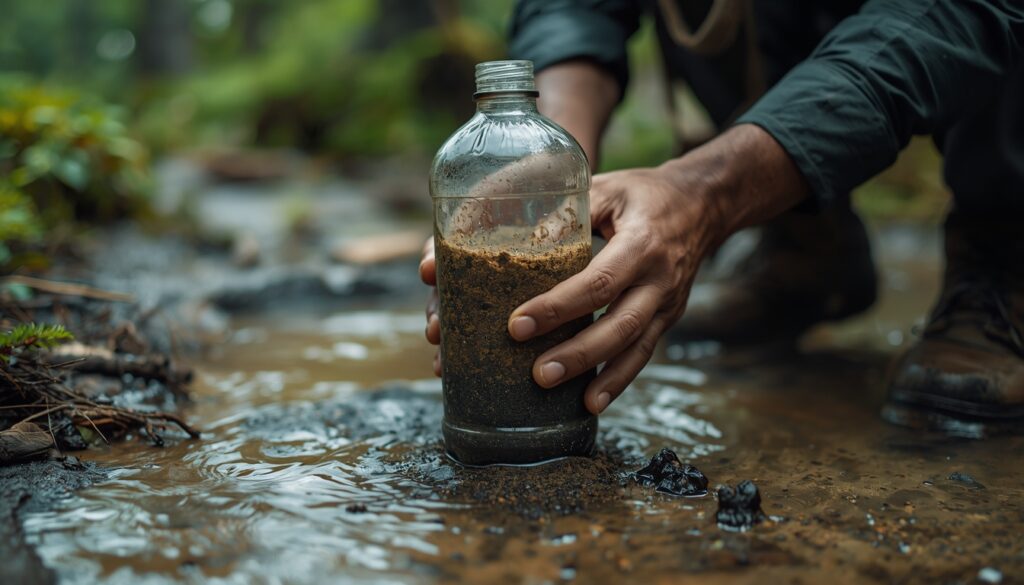
How much water do you need during a blackout?
How much water you actually need is often underestimated — and most figures are far too optimistic.
These are the real figures:
- 2 litres/day — absolute minimum (drinking only)
- 3 litres/day — BBK recommendation
- 7 litres/day — actual requirement including cooking, hygiene & emergency reserves
For emergency supplies, the rule is: plan for at least 3 litres per person per day — more is always better. If you want to be on the safe side, allow for 7 litres. That sounds like a lot, but it is possible to shower using 1.5 litres — if you know how.
Example for a household
4-person household:
- 2 litres per person → 8 litres per day (minimum)
- 3 litres per person → 12 litres per day (BBK recommendation)
- 5 people × 2 weeks = at least 140 litres = approx. 94 PET bottles (1.5L) = ~16 six-packs
→ For a 7-day minimum supply: 56 to 84 litres. Demand rises quickly.
How long should the supply last?
- At least 7 days (BBK recommendation)
- Even better: 10–14 days
- Optimal: 4 weeks — particularly during prolonged crises, supplies may be cut off for longer than expected
What water sources are available in an emergency?
If the water supply fails, you’ll need to use alternative sources. The most important ones:
- Rainwater (set up gutters, buckets, tarpaulins)
- Rivers and lakes
- Wells
- Stored tap water (collected before the failure)
- Public above-ground hydrants
Important: These sources are often contaminated and should never be drunk unfiltered.
Pro tip: Above-ground hydrant key
🔑 Hardly anyone knows this tip:
A street hydrant key costs around €30, is 60 cm long and weighs 2 kg. In an emergency, you can use it to tap into public hydrants — one of the safest and closest water sources in the city. Buy one now, while there’s still time.
Homework: Your water map
Before an emergency strikes: take a walk around your neighbourhood and create a mental (or actual) map of all water sources within a 1–2 km radius:
- Lakes, rivers, streams
- Hydrants and fire hydrants
- Empty houses with an outside tap
- Public fountains or water dispensers
Knowing where your water sources are in advance saves valuable time in an emergency — and helps avoid panic.
Safety rules for collecting water
In a prolonged crisis, fetching water can be dangerous. These rules apply for good reason:
- Go in pairs — never set off alone
- It is safer at night than during the day (less attention)
- Use small side streets rather than the main road
- Don’t carry too heavy a load — if you stagger, you’ll attract attention
- If in danger: drop your load and run — water can be replaced, you cannot
➡️ View the best water filters for emergencies
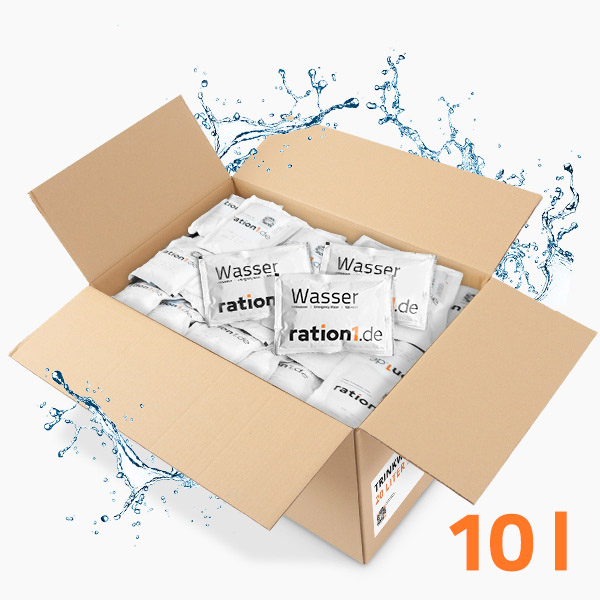
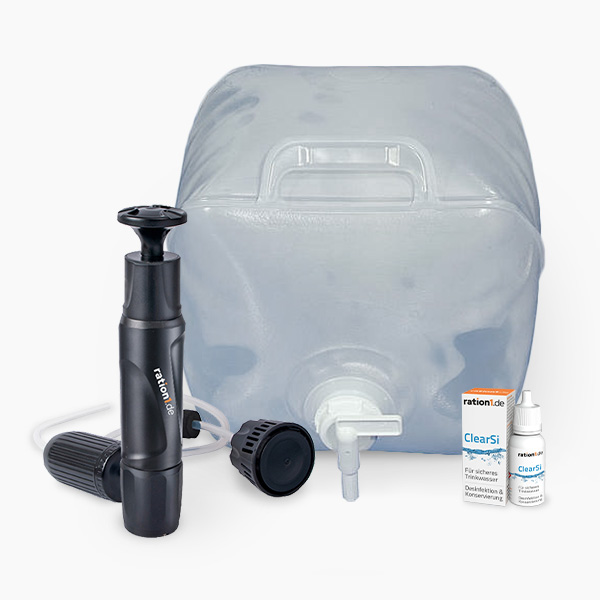
STORING WATER
As well as treatment, it is important to store enough water. With canisters and suitable containers, you can ensure you have enough for several days.
Water doesn’t have a proper expiry date — but it can still go off. For your emergency supplies, it’s important to know how long bottled water, tap water and spring water actually last.
How long does bottled mineral water last?
The best-before date printed on water bottles is not an indicator of the water’s quality — but of the packaging. Over time, PET bottles release microplastics and plasticisers into the water.
- Unopened PET bottle: Officially 6–24 months according to the label. The water itself remains drinkable for longer, but the quality deteriorates.
- Unopened glass bottle: Virtually unlimited shelf life.
- Opened bottle: Consume within 3–5 days.
Recommendation: Rotate your water supply every 12 months — use up the older water and buy new.
How long does tap water last when bottled at home?
If you bottle tap water in your own containers:
- In clean, airtight containers: 6–12 months
- In standard bottles: 3–6 months
Important: Rinse containers beforehand with drinking water and a drop of household bleach. Store in a cool, dark place. Replace every 6 months.
Signs that water has gone off
- Cloudy, greenish or brownish tinge
- Unusual smell (musty, chemical)
- Visible particles or deposits
- Slimy film on the bottle
If in doubt: it is better to treat it (filter, boil) than to drink it straight away.
The right way to store your emergency supplies
| Containers | Shelf life | Tip |
|---|---|---|
| PET bottles (unopened) | 12–24 months | Rotate annually |
| Food-safe containers | 6–12 months | Fill cleanly, store in a dark place |
| Glass bottles | Unlimited | Take care to avoid breakage |
| Foldable canisters | 6 months | For temporary storage only |
Golden rules:
- Store in a cool (below 20°C) and dark place
- Keep away from cleaning products or chemicals
- Do not place directly on the floor (temperature fluctuations)
- Labelling: Write the date of filling on it
What if you run out?
No problem — if you’re prepared. With a good water filter, you can turn water from streams, rain or standing water into safe drinking water.
👉 Water filter test: Which one really filters cleanly? →
What happens without preparation?
Without sufficient water supplies, things can quickly become critical: dehydration, poor hygiene, health risks. Clean water is the most important resource in an emergency — even more so than food.
Common mistakes with water supply
- Storing too little water
- Not having a filter solution
- Relying solely on tap water
- Failing to draw up an emergency plan
- Not knowing where local water sources are
A power cut rarely lasts just a few hours. And after 24 hours at the latest, water will no longer come out of the tap — because the pumps that push it into your home run on electricity.
What then? Bottled water sells out in supermarkets within minutes. Springs, streams and rainwater are not safe to drink without treatment.
In this article, I’ll show you the 8 most reliable methods for treating drinking water without electricity — from free to professional.
Why clean water is the biggest problem during a blackout
The human body can survive for weeks without food — but only 3 to 5 days without water. The BBK recommends at least 2 litres of drinking water per person per day. For a family of four over 72 hours, that means a minimum of 24 litres.
The problem: even if you have water in stock — what if you run out? Or if you’re out and about? Then you need a method to make raw water drinkable.
Method 1: Boiling (free, but limited)
Boiling kills bacteria, viruses and parasites. It is the oldest and most reliable method — with one crucial catch: you need heat.
Here’s how:
- Boil the water vigorously for at least 3 minutes (above 1,000 metres: add 1 minute for every 150 metres of altitude)
- Allow to cool and pour into clean, sealed containers
- Consume within 24 hours
Suitable for: Anyone with a gas hob, camping stove or wood-burning stove.
Not suitable for: Chemical contamination (industrial, agricultural) — boiling does not help in this case.
Method 2: Chemical disinfection with chlorine
Chlorine tablets (e.g. ‘Micropur’ or ‘Aquatabs’) are small, light and inexpensive — ideal for an emergency kit. If you don’t have any chlorine tablets to hand: ordinary household bleach works too.
Here’s how (with tablets):
- Roughly pre-filter the water (e.g. through a cloth) to remove suspended particles
- Add the tablet to the water according to the instructions on the packet
- Leave to stand for 30 minutes
Here’s how (with liquid chlorine):
- 2 drops per litre of water — no more
- Leave to stand for 1 hour — the water is then safe to drink
- Tip: Use a small spoon and a narrow plastic strip to help measure the dose
Suitable for: Cloudy water, short-term use.
Not suitable for: Long-term use (taste), heavily chemically contaminated water.
Method 3: UV sterilisation (fast, but expensive)
UV pens such as the ‘SteriPen’ irradiate the water with ultraviolet light and render bacteria and viruses harmless in 90 seconds.
Advantages: Fast, no chemical taste, very effective.
Disadvantages: Requires batteries, does not work with very cloudy water.
Tip: Combine with a pre-filter (Method 5) for maximum safety.
Method 4: Solar disinfection (SODIS)
Sounds simple — and it is. Fill PET bottles with water, place them in the sun, wait 6–8 hours. The sun’s UV light kills pathogens.
Here’s how:
- Fill a clear 1.5-litre PET bottle (remove the labels!) with treated water
- On a hot, sunny day, leave in direct sunlight for 6 hours
- If it’s cloudy: 2 days
Ideal for: Prolonged power cuts in summer.
Not suitable for: Cloudy water, winter, overcast weather.
Method 5: Water filter (the most reliable solution)
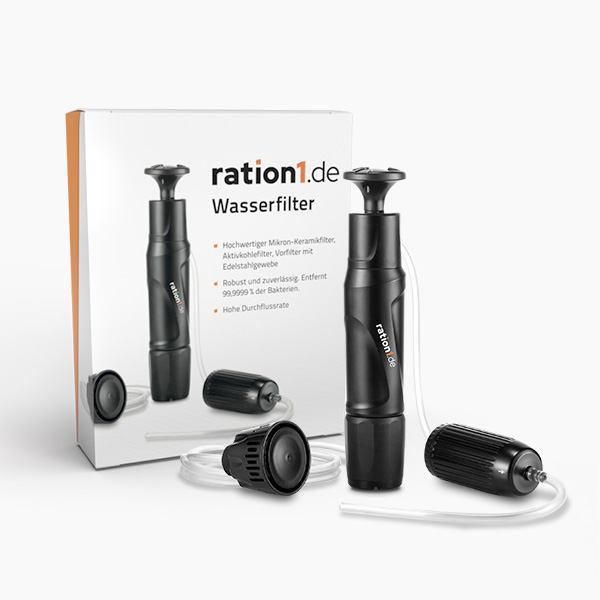
A good water filter is the most professional and versatile solution. It mechanically filters out bacteria, parasites and suspended solids — without electricity, without chemicals, without sunlight.
The best filters use hollow fibre membranes that filter out particles down to 0.1 micrometres. This is sufficient to turn river water, rainwater or pond water into safe drinking water.
What to look for when buying:
- Filter capacity: at least 1,000 litres (preferably 100,000+)
- Filter size: 0.1 micrometres or smaller
- Handling: can be used without a pump (gravity or direct filter)
- Certification: NSF or equivalent
👉 Which water filter is best for a power cut? Here is my detailed comparison →
Method 6: The 3-vessel method (for heavily contaminated water)
This method originates from the Foreign Legion and works even without any equipment — just time.
If the water is very cloudy or muddy, mechanical settling helps as a first step:
- Day 1: Fill container 1 with dirty water, cover it and leave it to stand for 2 days
- Day 2: Fill vessel 2 with more dirty water
- Day 3: Carefully pour the clear water from container 1 into container 3 — the mud stays at the bottom
- Day 4: Do the same with container 2 — container 3 now contains the clarified water
- Afterwards, it is essential to: boil or chemically disinfect
Suitable for: Muddy surface water or rainwater.
Important: This method only clarifies, it does not sterilise — always combine with method 1 or 2.
Method 7: The T-shirt filter method
Also from the Foreign Legion — works anywhere, requires only a T-shirt.
An improvised pre-filter for coarse dirt and particles:
- Twist the T-shirt into a tight tube
- Dip one end into the container of dirty water
- Hang the other end 25–30 cm deeper into an empty collection vessel
- The water seeps slowly through the fabric — coarse particles remain at the top
- Be sure to treat the water afterwards (boil or chlorinate)
Suitable for: Initial pre-filtration of stream or rainwater.
Important: Removes only suspended solids, not germs — always combine with another method.
Method 8: DIY water filter made from a PET bottle
A functional multi-stage filter made from everyday materials — requires only a 1.5-litre PET bottle and natural materials:
- Cut off the bottom of the PET bottle
- Fill the bottle from bottom to top (fine at the bottom, coarse at the top): cotton → fine sand → fine gravel → coarse gravel
- Drill a small 2mm hole in the lid (regulates the flow)
- Hang the bottle upside down (open bottom at the top, lid at the bottom)
- Pour dirty water in from the top → filtered water drips out at the bottom
- Then boil or chlorinate
Suitable for: Cloudy surface water or rainwater as a pre-filter.
Not sufficient for: Killing viruses or removing chemical pollutants — always follow up with further treatment.
Bonus: Extracting water from plants
In summer, and if you can leave the house, there is another source: plant transpiration. Birch trees, for example, release up to 100 litres of water per day through transpiration.
Here’s how:
- Place a clear plastic bag over the branches and leaves and tie it shut
- Place a stone in the bag to create a low point
- The vapour wets the inside of the bag and runs as water into the low point
- Set up several spots at once to collect significant amounts
The yield per bag is low, but in a real emergency, even this method can make a difference.
Which method is best?
| Method | Electricity required | Cost | Effectiveness | Suitable for power cuts |
|---|---|---|---|---|
| Boiling | No (heat source) | Free | High | ✅ Yes |
| Chlorine / tablets | No | Low | Medium | ✅ Yes |
| UV pen | Yes (batteries) | Medium | High | ⚠️ Limited |
| SODIS | No | Free | Medium | ⚠️ Limited |
| Water filter | No | One-off | Very high | ✅✅ Optimal |
| 3-vessel method | No | Free | Low (pre-filter) | ✅ As a pre-stage |
| T-shirt filter | No | Free | Low (pre-filter) | ✅ As a pre-stage |
| DIY PET filter | No | Free | Medium (pre-filter) | ✅ As a preliminary stage |
My recommendation: water filter as a base + chlorine tablets as a backup. The improvised methods (3-vessel, T-shirt, DIY filter) are only ever preliminary steps — they clarify but do not disinfect. Always combine with boiling or chlorine.
Conclusion: Water is not an option — it is essential for survival
In the event of a power cut, you won’t have time to worry about water. You need to have sorted that out beforehand.
The simplest and most reliable solution is a good water filter. Buy it once, stash it in your emergency backpack, and you can drink from almost any water source — no matter how long the power cut lasts.
👉 Here you’ll find my water filter comparison with the current test winner →
Don’t have an emergency backpack yet? Then take a look at my article on the perfect emergency backpack — the filter is an absolute must-have.
📚 Official recommendations & sources
- BBK (Federal Office for Civil Protection) — Emergency Supplies Guide
- World Health Organization (WHO) — Technical Notes: Water Requirements in Emergencies (PDF)
- Thomas Gast — Urban Survival (Foreign Legion methods for water treatment)
Last content review: June 2026 | Carried out by Wolf
🐺 Wolf – Author & Founder of blackout-ready.de
Wolf has been passionate about emergency preparedness and prepping for years. On blackout-ready.de, he tests products from personal experience and shows how to prepare yourself and your family for emergencies — no scaremongering, no fluff.